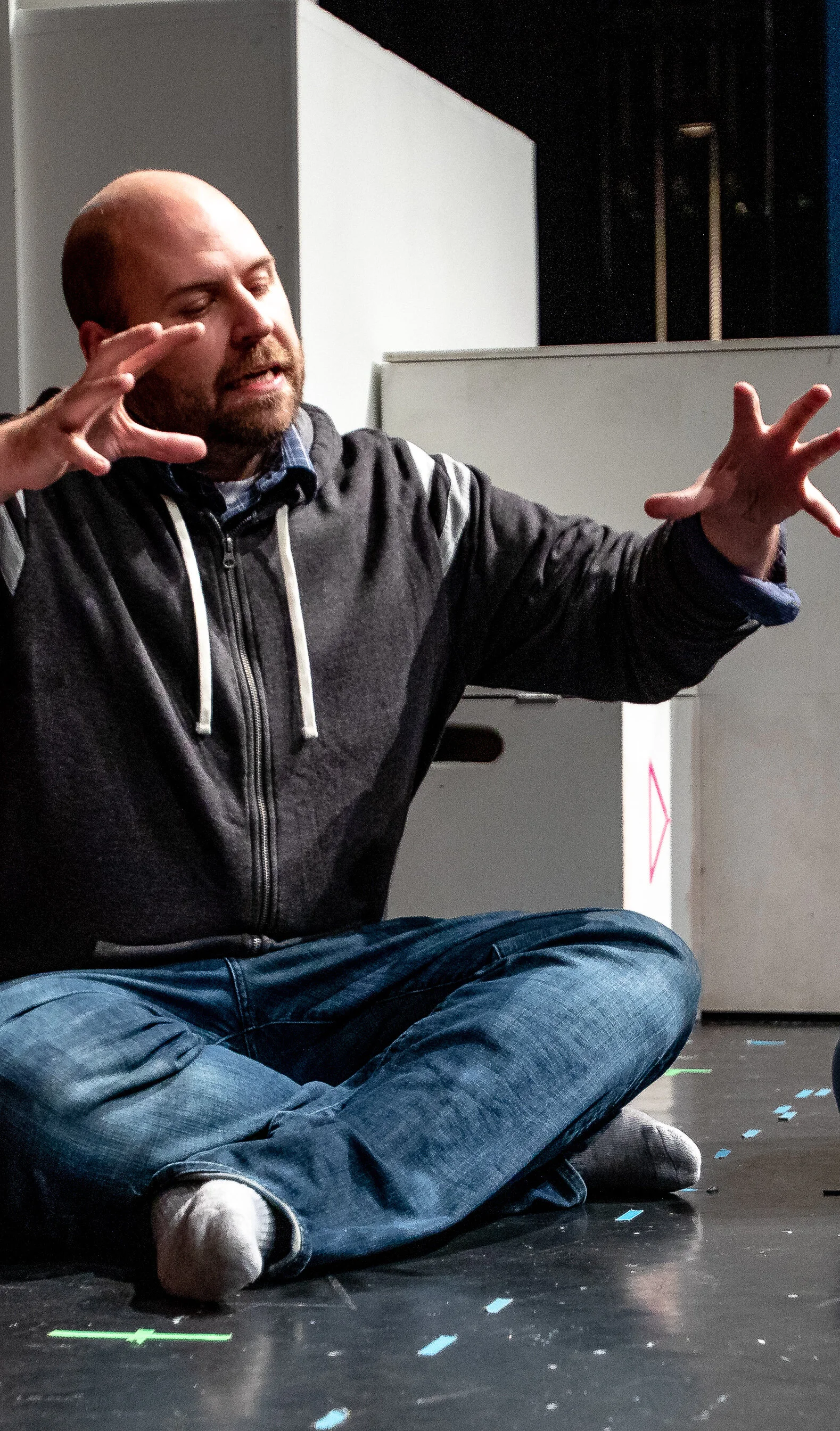
Directing The Curious Incident of the Dog in the Night-Time, Fall 2019
BIOGRAPHY
In 2016, I left New York City for Snow College, where I now serve as chair of the Department of Theatre. I teach acting, directing, voice and diction, and theatre history, and direct at least one production each season. Helping students grow into artists with control over their craft has been a deeply rewarding experience. I have found that while theatre is my passion, teaching is my privilege.
I am an award-winning professional director and actor, and have appeared on film, in many off-Broadway shows, and with prominent regional theatres such as The Guthrie Theatre, Actor’s Theatre of Louisville, and George Street Playhouse. I also toured for several years in repertory with the nation’s oldest and most acclaimed Shakespearean touring company, The Acting Company. I received my MFA from Mason Gross School of the Arts, Rutgers University, where I studied under the direct tutelage of experts in the Meisner technique, Uta Hagan’s work, the Michael Chekhov movement method, and Fitzmaurice vocal production. I’ve also studied with prestigious directors ranging from the Royal Academy of Dramatic Arts in London to the creative artists who formed The Atlantic Theatre Company in New York. I am excited to be continuing this legacy by sharing the craft of theatre with a new generation of students.
COMMITMENT TO EQUITY, DIVERSITY, & INCLUSION
We in theatre are the makers of other worlds — and thus, we are responsible for this one.
The stage is many things. It is a mirror to nature, a reflection of the time, a microscope of behavior, and a lab that conjures the best and worst of ourselves. But its core and most important state is people connecting to other people through story. Nothing is more powerful and delicate than that honest human connection. A moment on stage can shape an attitude. An image can guide a thought. Words can stir feeling and that feeling stir action. Carefully considering how what we do shapes those attitudes, those responses, and those actions is our responsibility as storytellers and even more so as educators guiding the next generation of theatrical artists.
Both stage and classroom can be swayed by bias, prejudice, and systemic forces. They can ignore plight and suffering in favor of pleasing narratives. They can decide some stories are impossible to tell, or futile, or too “niche” to captivate an audience or classroom. Practice and pedagogy may take safe harbor in orthodox approaches to avoid discomfort, and we may perpetuate and even elevate “the old way of doing things" without question out of ignorance, fear, or convenience. This happens on our stages and in our classrooms whenever those within them do not act with enough care and consideration. Coming from a place of privilege as I do, I know that I must do the work to avoid these biases by staying vigilant and ready to address unknown blind spots.
I believe that to be a responsible crafter of theatre and education, I must make time to examine myself, my practices, my content, and my institutions — with a wary eye, a doubtful one, an honest one. I work hard to acknowledge my own responsibility and power as an artist and educator. Because my privilege and influence impact others, I want to decentralize my experience and to listen to other perspectives with humility, generosity, and empathy in order to continually improve myself and my work. My goal is to advocate for a chorus of voices to sing in the theatre, both on and off stage. Here are some principles for which I strive and will continue to strive:
To listen more and talk less.
To ensure each of my student’s and colleague’s voices are raised, heard, and respected.
To promote safe and equitable spaces where every person’s story can be told and honored.
To commit to art, theatre, education that is anti-racist, where hate, bigotry, and intolerance are not given power.
To interrogate myself and systems I am a part of to disrupt the structural inequalities and systemic barriers that exclude, impede, or lessen underrepresented communities.
To nurture growth in theatre for the individual artist and for the community, to support new facets of theatre and artistic expression.
To advocate for open discourse toward positive change.
To work to give resources and access to any who wish and to work to remove impediments to that access.
To take responsibility for my artistic actions and hold others accountable for theirs.
A theatre department’s programming is one of the strongest ways it can advocate for diversity. The season must include playwrights of color, women, and the LGBTQ+ community. Productions must promote cultural sensitivity. Casting must be open and flexible to give the full spectrum of students’ opportunity. Departments must make movements toward accessibility beyond seating with accommodations such as signed performances, audio descriptions, and yes, content warnings. All of the above must be handled with humility and generosity. And to complicate matters, you must do all of this while still bringing in people to watch — because how can you tell anyone’s story when no one is listening?
One area of diversity that we in the arts need to think hard about is how to make sure we include students from diverse socioeconomic backgrounds. All too often theatre has been considered an “elitist” project that implicitly excludes those without rich economic and educational backgrounds. Recent studies have shown that socioeconomic stressors have an increasingly isolating and academically detrimental impact on students across college campuses today. In my time at Snow College, I have been on the ground floor working day in and day out with students who struggle financially to stay in college, much less to justify such “frivolous” study as theatre. From working with students on textbook costs, making technology available, and scheduling rehearsal around needed work hours to selecting some material that mirrors the experience of economic struggle, I try to always ensure that the experience of theatre I provide students is inclusive of all students,
Theatre should and must be a place for all, in all of its places. It both can and must startle and awaken students and audiences alike. It is a place of education, challenge, democracy, and revolution. And it may be one of our best tools to come together and harmonize.
I hope to make this world a better place through the worlds I make on stage.